Greetings from Cape Town,
We are waiting and praying for rain…….. Hope a
miracle will happen soon as the Western Cape is so dry. My, how the
time flies. I have had such a busy December and
going into the new year with moving house and also on tour that it is March
already. Hoping you all had a fabulous
Christmas and a very busy start to 2018.
In our November Newsletter I said I would tell you about our trip to
St. Lucia. After visiting Shakaland and leaving just after
breakfast we travelled toward the coast to visit the
St Lucia Wetlands or rather iSimangaliso (meaning “a miracle” or
“something wondrous” Wetlands, which came about as a
result of Shaka’s subjects having been sent to the land of the Tsonga
people. The park is a huge protected area along the
coast of South Africa’s Kwa Zulu Natal. The park’s centre piece is the
vast Lake St Lucia, home to a large number of
hippo’s, crocodiles, pelicans and flamingos.
Elephants,
giraffes and leopards inhabit the grasslands and forests of the nearby
Western Shores.
This was already established
in 1895 and in 1999 the park was proclaimed South
Africa’s first World Heritage Site by UNESCO and also has the highest
vegetated sand dunes in Africa. These impressive
dunes have been built or sculptured by the wind over the past 25 000 years,
rising from the waves of the Indian Ocean.
Everyone was very excited to get on board the “Advantage Cruiser” to
see the Hippo’s and crocodiles in the river. It was
absolutely amazing to see these large mammals move so
swiftly in the water. They do sometimes visit the town of St Lucia in
the evenings, as you will notice signs on the side of
the road, saying Hippo’s crossing. The trip up the river is
usually about 2
hours, so drinks are also available on board. The
Captain of the cruiser is a lovely young lady who points out all the
Hippo’s
and adds the necessary information, plus tells us
about the various birds in the area or crocodiles. After a very
success morning
we then went over for our finger lunch at the local
Sizzler’s restaurant nearby.
For more information contact - Riette - 035 590
1259 - www.advantagetours.co.za
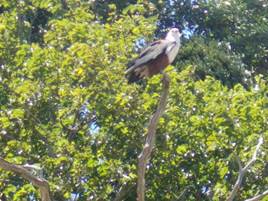
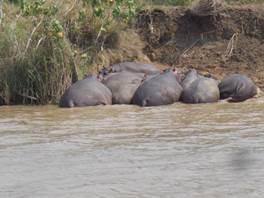
A Fish Eagle in a nearby tree Hippo’s relaxing in the sun
During December
and January our tours took me back to the Battlefields and also new places
I had not been, or places that I
have not seen for a long time. Our visits back
to Isandlwana and Rorkes Drift Battlefields were as usual always a pleasure
for
me. I look forward to these interesting visits
where the Battlefield Guides are so enthusiastic about their
history. At both
Isandlwana and Rorkes Drift we had Dolton, who is a Zulu and who had grown up in the area of
Isandlwana. He can speak
for hours about both these Battlefields and keep his
listeners on the tip of their chairs with his stories. Accommodation this
time was at the Isandlwana Lodge which is built into
the rock face on the Battlefield. The Lodge was opened in 1999 by
Prince Mangosuthu Buthelesi, a great grandson of
Mnyamana Buthelezi, it overlooks Isandlwana Battlefield, where Ross
and
Shane are the managers of this authentic lodge. The
views are breath-taking from the Lodge as you look over the village
onto
the Battlefield.
There are 12 bedrooms each with its own balcony where you can relax while looking
over this same view. Three meals
are
prepared daily for the guests. Doltan, the local Historian will brief the
guests about the battlefields before we leave for our
walk and also to take photographs. This takes place in the morning straight
after breakfast.
For more information contact - Ross - 034 271 8301 - www.isandlwana.co.za
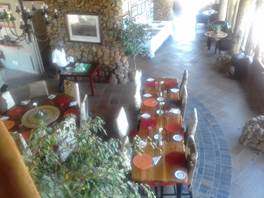
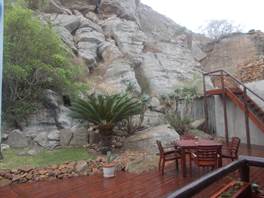
Isandlwana Lodge dining area
Isandlwana outside dining area
The Battle of
Isandlwana was on the 22n January 1879. This was the first
encounter in the Anglo-Zulu War between the
British Empire and the Zulu Kingdom. The Battle of
Isandlwana remains the single greatest defeat of the British army at the
hands of 20,000 Zulu warriors who attacked a portion
of the British main column consisting of about 1800 British,
colonial,
native troops and possibly 400 civilians. The
Zulu’s were equipped with traditional Assegai spears, and cow-hide shields,
but also had a number of muskets and old rifles,
although they were not formally trained to use. Killing over 1,300 troops,
including all those out on the forward firing line.
The Zulu army suffered anywhere between 1000 – 2500 who were killed.
The Battle of Rorke’s Drift, also known as the Defence of
Rorke’s Drift, was the defence of the Mission Station at Rorke’s
Drift, under the command of Lieutenants John Chard of
the Royal Engineers and Gonville Bromhead. Immediately, following
the British Army’s defeat at the Battle of Isandlwana
on 22 January 1879, and continued the following day.
Just over 150 British and colonial troops
successfully defended the garrison against an intense assault by 3,000
to 4,000 Zulu
warriors. The massive but piecemeal Zulu attacks on
Rorke’s Drift came very close to defeating the much smaller garrison,
but were ultimately repelled. Eleven Victoria Crosses
were awarded to the defenders, along with other decorations and honours.
It was the only Victorian Crosses handed out during
the Anglo-Zulu war.
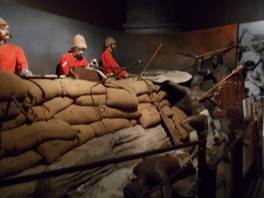
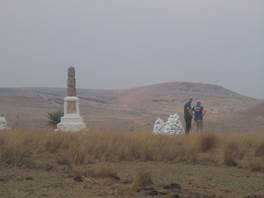
Inside Rorke’s Drift Museum Isandlwana Battlefield and Graves
One of the favourite places we also visited was way
up in Pongola,
Kwa Zulu Natal where we had some amazing game viewing
before the end of our Battlefields Tour which was of
course, Amakhosi Lodge not far from Vryheid.
Everyone always
finds this Lodge so relaxing after the long drive and also trying to absorb
all the places and things they have
seen on the tour. This delightful hideaway has
wonderful chalets right on the river bank where you can view the Big Five from
the wooden deck at your chalet. Morning
and evening game drives are offered daily. The morning starts with a 4.30 wake-up
call! Tea and coffee is served before we
take off at 5.00am. They have very knowledgeable Game Rangers who
really take
care of you and somehow manage to let us see the most
amazing animals every time.
Around 7.00 am we are once again served with
coffee and delicious biscuits and treats, after which we set off again
looking
for more animals to photograph. Breakfast
awaits us around 9.00 am after our successful game drive. We have
been very
fortunate, that every time we have been at Amakhosi
we have had beautiful weather. They were also hoping for rain, but
since the end of January some rain has been falling
in Kwa Zulu Natal, so no doubt they will be having wonderful green grass
and trees and rivers flowing through their grounds
for the animals.
For more information contact - Sonja at Amakhosi Lodge
- 034 414 1157 - www.amakhosi.com
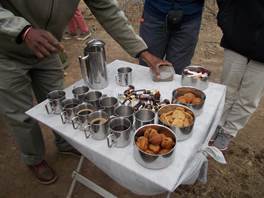
Coffee and eats on Game
Drive
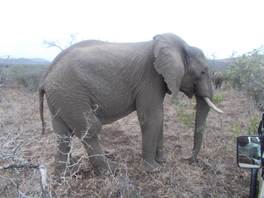
One of the many elephants
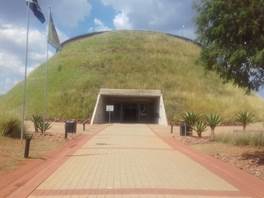
Our next tour took us to visit the Cradle of
Humankind northwest of Johannesburg, in the Gauteng Province, which has been
a World Heritage Site since 1999 and currently
occupies 47,000 hectares (180sq mi) and also contains a complex of lime
stone
caves. The registered name of the site in the
list of World Heritage Sites is Fossil Hominid Sites of South Africa.
This the clients found very interesting as there was so much to
see. There are many caves in this area where these early fossils
were found by local geologists about 48 years
ago, and are possibly over 2-3 million years old, such as the fossil
Australopithecus Africanus (nicknamed “Mrs Ples”)
found in 1947 by Robert Broom and John T Robinson. (Should
any of you wish to have more information, please do not hesitate
to contact me). We also went to visit the Sterkfontein Caves where the site of many of these discoveries were made in
1924, such as the juvenile skull known as the “Taung
Child” by Raymond Dart, at Taung in North West Province. Excavations here still continue!
Below is a photograph of some of the brave clients who went
underground into the Sterkfontein caves, and enjoyed the
experience very much.
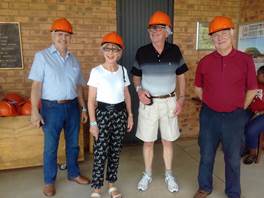
Clients
ready to go down
under
The entrance to the Cradle of Humankind
Our next
adventure was visiting the Limpopo Province. All the way to Entabeni
Conservancy to stop over at Lakeside
Lodge. What an awesome experience we
all had as this is part of the Legend Lodges. We were able to see so many animal.
We also, visited their fabulous Golf Course and
also saw White Lions as well as a Pedi Village. The Entabeni Game Reserve
is a 220km (85 sq. mi) private
reserve situated in the Waterberg in Limpopo Province. Entabeni means ‘Place
of the Mountain”.
The reserve is home to the
Transvaal lion, African bush elephant, South African giraffe, the African Leopard,
South African
cheetah, warthog, hippopotamus
and other safari animals. The reserve is owned and operated by Legend
Lodges, and also
has a Nature Guiding Training
school. It is also situated in the World Heritage Waterberg Biosphere
and is
around a 3 and
a half hours drive north of
Johannesburg. This 22,000 hectare malaria-free reserve boasts five
eco-systems.
The accommodation consists of
thatched roof cottages next to a picturesque lake, with
thatched walkways to the cottages, and
pathways from each cottage to the
main reception area and facilities.
For more information contact
Lakeside Lodge - Mishack - 014 743 6050 - www.legendhospitality.co.za
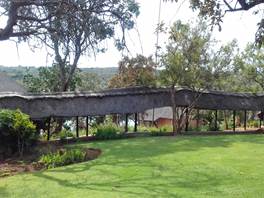
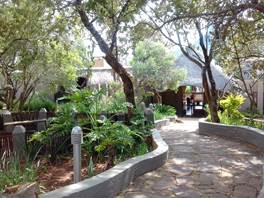
Walkway to
dining room Entrance
to Lakeside Lodge
Our next stop was at the Mapesu Private Reserve where
we stayed over at the Mopane Bush Lodge for 3 nights. The
Reserve adjoins the Mapungubwe National Park yet another World Heritage
Site. The Mapesu Private Game Reserve is well known for its Mopane trees and for housing a 4
star lodge, namely Mopane Bush Lodge. The Reserve also falls within the
Savanna bioregion and more specifically the Musina
Mopane Bushveld vegetation type, which seems to be homogenous.
Apart from the dominant mopane vegetation, other tree
species also occur, and include the locally distributed vlei thorn, three
hook thorn, num num, purple cluster leaf, fever
trees, camel thorn, shepherds tree to name a few. Their mammals include
zebra, blue wildebeest, eland, waterbuck, impala,
kudu, steenbok, duiker, baboon, monkey, bush pig, warthog too many to mention - and of course the Transvaal lion, South
African cheetah, African elephant as well as Cape buffalo. There are also over 383 bird species and many reptiles including the Rock
monitor lizard, night adder, spotted bush snake and African python
to name but a few. We were fortunate to view see some
Khoi San Rock paintings and have a few Game Drives.
The Mopane Bush Lodge consists of 12 bedroom
facilities where each one has a separate thatched roof cottage and a
picturesque dining area supplies
scrumptious breakfast, lunch and dinners.
For more information contact - Brigitte -
015 534 7906 - www.mopanebushlodge.co.za
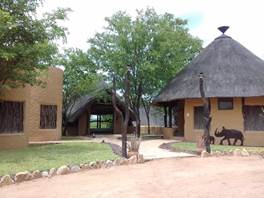
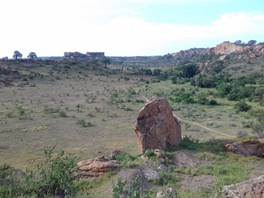
Entrance to the Mopane Bush
Lodge Mapungubwe
National Park
A quick visit through Musina, the most northern town
in Limpopo Province, near the confluence of the Limpopo and
the Shashe
rivers and the border of Zimbabwe meet. It has a population of between
20,000 – 40.000 and has the busiest
border
post at Beitbridge which is the link to Zimbabwe. It mines iron ore, coal,
magnetite, diamonds, semi-precious
stones
and copper in the region.
We are now on the way to Chisomo Safari Lodge situated in the
Karongwe Private Game Reserve. The camp consists of well
appointed tent accommodation, each with its own
wooden deck where to you can look out onto the bush and view some of
the Big 5. Two game drives are offered daily
with qualified rangers and high tea is served in the afternoon before the
game
drive. Amazing dinner is served in the dining
room or in the Boma (weather permitting).
We
saw many buck like Impala grazing outside our tented accommodation during
the day and evening. A Spa is also available
for the guests.
For more information contact - Landi - 015 383
9910 - www.karongweportfolio.com
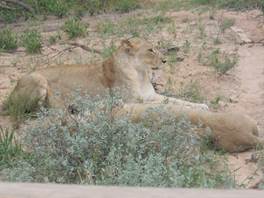
Entrance to the Chisomo Safari Camp
Two female lions
During our visit at Chisomo we also managed to visit
Moholoholo Wildlife Rehabilitation Centre situated in the shadow of the
majestic “Mariepskop” where their unique conservancy
is home to many wild animals. Wherever possible, rehabilitated birds
and animals are returned to the wild and those that
are not so fortunate due to the nature of their injuries are used to
educate the
many people who visit them each year. Moholoholo also
facilitates a number of successful breeding programs. Animals to be
seen are Lion, Leopard, Serval, Honey Badger, Eagles,
Vultures and wild dogs. A visit to their centre stimulates awareness and
understanding of the plight which our wildlife faces.
For more information contact - Meska - 015 795
5236 - www.moholoholo.co.za
After our stay at Chisomo Safari Camp we wended our way through the
Panorama Route visiting The Three Rondawels,
Bourke’s Luck Potholes and of course God’s Window, although a bit
misty, it was still lovely to see. More about these amazing
sites in my following newsletter.
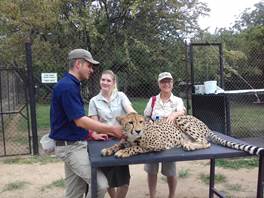
Touching a Cheetah at
Moholoholo
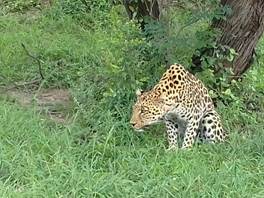
A shy Leopard at
Moholoholo
After this inspiring visit at Chisomo
and Moholoholo we carried on to Imbali Safai Lodge located in the
Kruger National Park.
The
guests are accommodated in 12 spacious suites, subtly decorated in neutral
shades with splashes of colour of African
tradition, plus ornate wall lamps and textured
pillows. Large French doors run the length of the room to let in as
much view
of the natural surroundings. The expansive deck also
has a splash pool or Jacuzzi for your outdoor experience. Spa treatments
are available daily. You can enjoy two game
drives and a high tea is once again ready before your late afternoon game
drive.
Breakfast, lunch and Dinner is served on an open
wooden deck overlooking the waterhole where many animals are
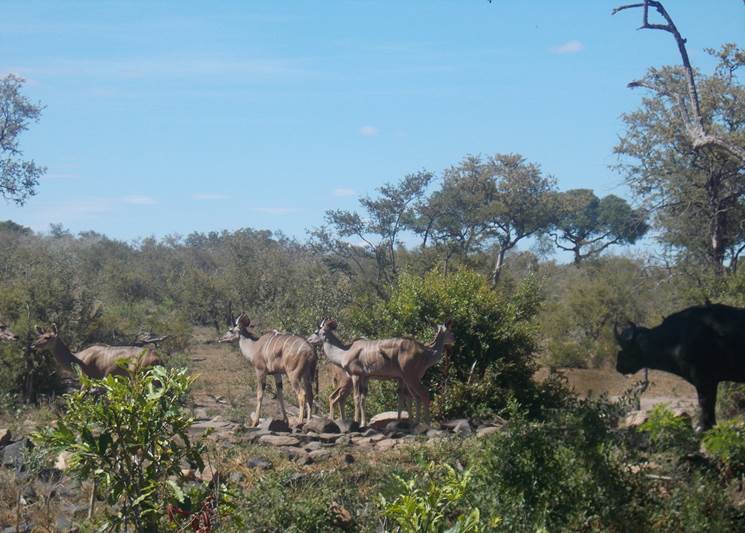
always on
view, such as elephants and a variety of other
animals as seen in our main photograph at the top of our newsletter.
For more information contact - Julia or Leon -
013 735 8917 - www.imbali.com
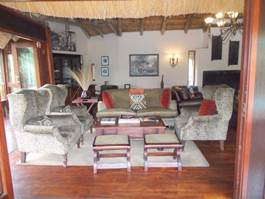
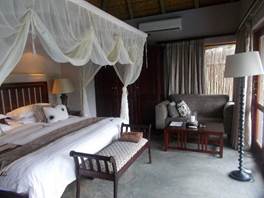
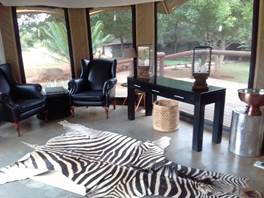
Imbali Lodge Lounge
area Imbali
Lodge accommodation
We hope you have all enjoyed reading about this exciting trip with us, and
hope that one day you will also be able to go and
visit some of these marvelous venues and enjoy
our country just as much as I do when out of the city and in the bush or
countryside. It is an honour to share all
these lovely places with my members, friends and clients. I promise my
next newsletter
will be done shortly as I still have much to tell you
all about South Africa.
Warm Regards and God Bless,

Thought
for the day:
Whatever your hand finds to do, do
it with all your might…
ECCLESIASTES 9:10
Corbett
Tourism Consulting, Marketing and Tours
Cape Town, South Africa
Mobile: +27 (0) 747 092 502 / 073 1409 700
elainecorbett@ctcmarketing.co.za
www.ctcmarketing.co.za


|