|
Greetings from a very hot Cape Town ,
August last year we had the pleasure of being
invited by the Northern Cape Tourism Bureau to visit Sutherland on an
educational. The group consisted of Tour Operators, Guides, Consultants
and Marketers. None of us had ever been to Sutherland, so we were all
very excited. Needless to say the weather was cloudy and cold when
we left, so were hoping that it might snow, as Sutherland normally gets
snow in July August. So all the woolly clothes were packed ready
for the trip. Well, unfortunately, we had no snow but beautiful warm
sunny weather……
My newsletter this month will be dedicated to this
amazing trip we all enjoyed as Sutherland is one of those towns that you
have on your bucket list and say, next year we will go see the snow, and
that next year somehow never materializes.
Sutherland is in the heart of the Roggeveld region – named in
reference to the naturally occurring wild rye grass (Secale
Africanum). Early scouts considered it to be promising for sheep
farming, which is why pioneer farmers ventured over awe-inspiring
terrain, across immense distances and forbidding mountain ranges to
settle in the area.
After the
arrival of the first white pioneer travelers and farmers in the 1700s and
early 1800s, the Dutch East India Company advanced capital for the
establishment of farms across vast tracts of land. These farms are today
written into the region’s history with Dutch names like Uitkyk, De Guns
Fonteyn, Klipfontein, De Knolle Fonteyn (Kanolfontein), De
Jakkalsfontein, De List and Cylenberg.
Despite clashes with the resident KhoiSan
populations, the settlers remained and continued farming.
Sutherland
was part of the Worcester district, whose religious well-being was
overseen by one Dominee (Minister) Henry Sutherland. In time, the Dutch
Reformed Church bought De List farm as a church farm to serve the
population of the Middle Roggeberg. They held their inaugural
church advisory meeting in 1855 as the “Middel en Kleinroggeveldsche
Gemeente” (Middle and Small Roggeveld Congregation).
Two years
later in 1857, the Worcester Municipal Council instructed that the farm
De List be divided into 50 properties which could be sold to private
individuals to form a church town. The town was to be named after Ds
Henry Sutherland.
In 1858
the cornerstone of the first church was laid and in November of the same
year, the first properties were auctioned and the hamlet of
Sutherland officially became a dot on the map of the world.


Sutherland is the site of some fascinating
and rare plant life. Not much rain falls in the district. When it does,
the dry earth responds by erupting almost overnight into a multi-coloured
carpet of wild flowers that stretches for kilometres in the nearby
Hantam-Roggeveld. Plant enthusiasts can explore the Sutherland Tanqua
Route, which forms part of the Succulent Karoo Ecosystem Plan (SKEP), and
visit the 260ha Sterboom Natural Heritage site. And remember that spring
is an excellent time to visit Sutherland, with enough rain the region is
painted with colourful veld flowers. Also visit Middelfontein Guestfarm
for their Veldplant Route.
  
The main entrance to the town is marked by a memorial to the Voortrekkers,
the colonists who opened up much of South Africa’s interior, in
celebration of the 150th anniversary of the Groot Trek. The town’s only
museum, the Louw Huis or Louw House, houses artefacts belonging to the
family Louw – a famous name in South African literature. The house was
the birthplace of NP Van Wyk Louw and his brother WEG Louw. The
original house dates back to 1861. Motlkie Louw purchased the house
in 1904 and added the concave verandah. After what he described as an
idyllic childhood in Sutherland, NP later found himself separated
from it and was moved to verse, stark with haiku-like words of longing
for his beloved Karoo. This excerpt was written in Amsterdam, where he
was studying at the time.
The
Louw House Museum
bears witness to the cultural history of the area with farm implements,
clothing and furniture donated by Sutherland’s residents and farming
community.
To book a tour to the Louw House Museum in Jubilee Street
contact: +27 (0)23 5711 131
 
Early photos of the town show that most buildings were gabled in the Cape
Dutch fashion. As the Victorians swept in, gables and thatch or
clay roofs went out of fashion, to be replaced by verandas and corrugated
iron roofs. The remains of stone walls and other stone buildings are
dotted around town, giving Sutherland its warm, rustic character. A
walking tour of the town will take you past most of the architecturally
prominent buildings .
By 1872 the town had a population of 138 registered
citizens living in 19 houses. The large Dutch Reformed church in
the centre of Sutherland was built in 1899
During the Anglo Boer
War the church was used as a fort by garrisoned British
soldiers. During the war a number of engagements between British and Boer
forces occurred in the town. In one such engagement a force of 250 Boer
commandos attacked the local British garrison for 10 hours. The ruins of
a fort can be found on the outskirts of town on the hill called
Rebelskop. This was named after this engagement.
The NG Church building in the main street is a must-see.
It was designed by architect Charles Freeman. The consecration of the
church took place on 25 April 1903, with an assembly of 1200 people.
Graffiti scribbled on the walls by the British troops are still visible
today. The church also houses a unique German organ, said to be one of
two left of its kind.
To book a tour +27 23 571 1258 | +27 71 136 7468.
 
This was the first main route leading hunters, explorers and fortune
seekers from the Cape of Good Hope to the interior and the great north.
With the advent of tarred super-highways, the route was largely forgotten
until 4x4 enthusiasts led the charge to explore its extensive unpaved sections
and started calling it The Forgotten Highway. Heading out of
Sutherland, take the R356 or, 26km out of town, turn right along a road
marked “Posroete”. This takes you along the Nuweveldberge escarpment with
spectacular view over the Swartberge. Ouberg Pass 45 kilometres from
Sutherland and 1 404 metres above sea level is one of the most
spectacular routes across the Roggeveld mountains. It was picked out by
pioneer farmers when the choice of travel was foot slog, horseback or ox
wagon. Nearly 100 years later, in 1969, the first proper road was
finished over the pass
Over 25 000 years ago, the KhoiSan or Bushmen people who
inhabited this region knew that time is in the stars. They had a
remarkably extensive knowledge of the stars and wove this wisdom into the
rhythm of their lives. The 19th-century scholar Dr
Wilhelm
Bleek, who studied their languages and analysed their legends,
found evidence that the Bushmen seemingly observed the movements of the
planet Jupiter and its four main moons with the naked eye. These Bushman
legends date back to before Galileo made his observations with his first
telescope.
Like the
earliest people, we are still awed by the mystery of the stars, planets
and distant galaxies. Today, the extraordinary clarity of Sutherland’s
cloudless, pollution-free night skies and its high elevation above sea
level makes it a prime star-gazing destination and the perfect site for
the South African Astronomical Observatory.
 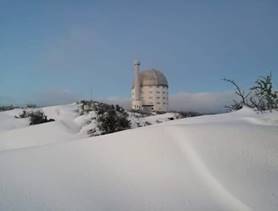
The observatory houses the largest single optical telescope in
the Southern Hemisphere. Based on the design of the Hobby-Eberly
Telescope in Texas, it consists of a primary, hexagonal mirror 11
metres wide made up of 91 individual hexagonal mirrors, each one metre
wide and weighing about 100kg. This great eye probing the universe is
sensitive enough to pick up the light of a single candle on the moon –
but its main job is to scan deep space, witnessing the birth and death of
planets, gazing into distant galaxies and recording the scale and age of
the universe, stars, galaxies and quasars billions of light years away.
Amateur star-gazers can set up their own telescopes at the
nearby visitors’ centre.
The facility is open to the public with four evening tours a week and 12
daytime tours.
• Visitors can choose between a fully guided tour (Mon-Fri
10:30 and 14:30; Sat 11:30 and 14:30) or a self-
guided tour.
• Night Tours entail the viewing of interesting objects in the sky
through two dedicated visitor telescopes.
SALT itself, is not visited at night.
• The tours are normally at 18:00 in mid-winter and at 20:00 in
mid-summer. Please note that the times of tours
are merely an indication, confirm with the Observatory.
Contact:
+27 23 5712 436 | suthbookings@saao.ac.za
| emergencies dial +27 76 900 0308
On several game farms in the Western Cape you hear about the big five,
but in Sutherland we are honoured to present the Celestial Big Five
and where else but at Sterland, just one kilometer outside
Sutherland, in the direction of Matjiesfontein. Regular Stargazing
sessions are presented every night, right throughout the year and not
even the coldest night keeps stargazers away.
 
Sterland
Stargazing:
Cold air provides excellent viewing of the Milky Way and Deep Sky Images.
Bookings are essential. The show at Sterland starts at 20:00 lasting two
hours.
The stargazer is first treated with an indoor presentation on a three
meter big screen explaining all the constellations and sizes in the
universe. They will also introduce you to some fossil samples plus
the history.
A short DVD about Sutherland is shown. Inside the dam are numerous
posters of Astronomy and books to be read. After that the stargazer is
taken outside to the Muisbos Amphi theatre and first treated with an
explanation of how to find South, with the aid of the Magellan Clouds, Southern
Cross and other stars. They make use of a very powerful laser so
that each person can see what we are talking about. All the relevant
constellations, stars, planets and objects to be observed are then
explained before looking through the eye piece.
 
Stargazing - Your visit is not complete
without Sutherland Planetarium in the main road. During
daytime, your whole family can enjoy digital shows in a full 3D full dome
space and astronomy presentation.
Find souvenirs and delicious coffee before your show. During the digital
show inside the dome, you can learn all about the constellations before
you see the real thing at night.
The professional guide at Sutherland Planetarium will point out the
constellations with a lazer at night, while you can view the stars
through the largest privately-owned telescope in Sutherland (14
inch Celestron).
Please note: A maximum of 30 people is allowed at a time, so please book
to avoid disappointment
TIMES FOR
STARGAZING: 19:00 in Winter 20:00 in Summer
Stargazing
lasts for about 90 minutes. We will keep you warm with blankets and warm
drinks are available.
FOR MORE INFORMATION ON BOOKINGS, WHERE TO EAT AND STAY, OR LOCAL TOURS
OF THE AREA
Visit Discover Sutherland’s office at Sutherland
Planetarium in the main road.
Contact: Alta Steenkamp on 076 969
8635 (WhatsApp or Call) info@discoversutherland.co.za
www.facebook.com/discoversutherland.co.za
www.discoversutherland.co.za
.
Sutherland also has a winery, Alpacas on a
farm, 4x4 tours in the mountain, and many Guest Houses,
Self-catering and of course amazing restaurants that has wonderful local
cuisine. Just remember they are far from the ocean in the Karoo so
please do not expect a seafood
platter. Their lamb chops are the best in the world. Wonderful
fresh vegetables and fruit always available.
We hope many of you shall take a drive up to
Sutherland, and you really do not have to wait for the snow. A three
night stay is advised if you really want to enjoy your trip and visit all
the interesting places to see, and appreciate the fresh air and the local
hospitality.
Till next time.
Warm Regards and God Bless,
.

|


